

Before people arrive — and after the last one leaves — walk through your building. Whether you are starting a safety plan or strengthening one, one quiet interior pass is a caretaking habit that fits a small church.
An analogy that sticks
Think of a caretaker who walks the house before guests arrive and again after the last car pulls away. They try the side door, glance into empty rooms, check hall lights, look at the first-aid shelf, and make sure the kitchen stove is off — not because they expect disaster, but because small problems are easier to catch when the building is still quiet. An interior church patrol is that same walk, done for the flock, before and after every gathering — Sunday or midweek.
What to notice on the pass
Check interior doors and fire exits — clear, nothing propped open, and required exits still free from the inside. Look into empty rooms; lock what should stay locked without blocking escape routes. Walk the hallways and stairs — clear paths and working lights. Glance at extinguisher gauges (needle in the green on gauge-equipped units) and the AED's readiness indicator. Confirm radios are seated in their charging cradles. Check restrooms and the kitchen for dripping faucets or leaks. Then log it — what you found, who you told, and a few photos.
The short covers that core pass. This article adds a same-channel radio check, plus items cut for length: the children's wing, unattended items, fuller safety and kitchen notes, and the closing walk.
What to do this Sunday
Arrive early enough for one unhurried pass — or assign the closing walk to the last person locking up. Bring a phone for notes and photos. Before people arrive, do a brief radio check from each posted station on the same channel. Report anything urgent before the foyer fills. Keep the tone caretaking, not fearful. It's a simple way to start — or strengthen — your safety plan.
- Interior doors and fire exits clear; nothing propped; required exits free from inside
- Unused rooms checked; secured without blocking required exits
- Hallways and stairs: clear paths, working lights
- Extinguishers present/unblocked; gauges in the green where equipped
- AED readiness indicator checked (per the unit's instructions)
- Radios in charging cradles; radio check from each station on the same channel
- Restrooms checked (help needed, leaks, left-behind items)
- Children's wing / nursery: access as intended; nothing out of place
- Kitchen: leaks, stoves and appliances off, nothing left running
- Wet floors, ceiling stains, or unusual smells noted
- Unattended bags or packages calmly reported to the team lead
- Closing walk: lights off, windows shut, building empty, doors locked
- Findings logged with photos and who was told
Have 2 more minutes? Here's how to put it in place.
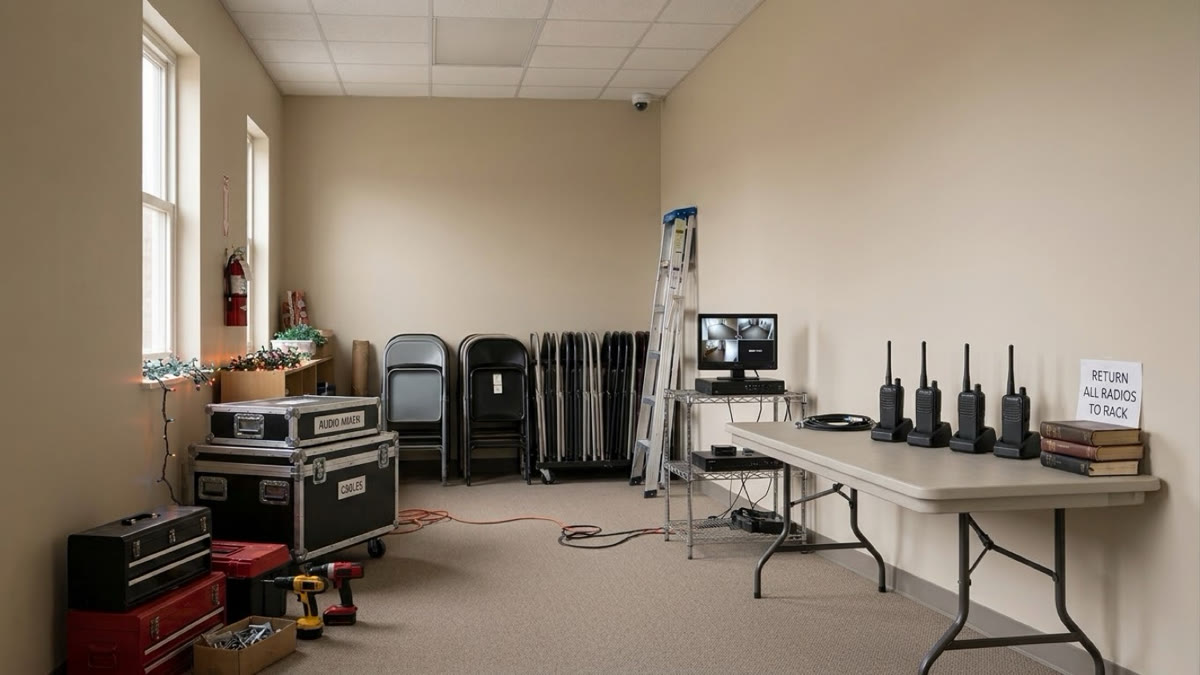
Doors, unused rooms, halls, and stairs
Start with doors and fire exits: clear paths, nothing propped, panic hardware free, and required exits still usable from the inside. Then unused rooms — look in, then secure what leadership wants locked, without latching people out of an escape route. Walk the hallways and stairs for trip hazards, bags in the path, and burned-out lights. If two people share the pass, split the list and meet at the radio cradle rack before one message goes to leadership.
Radios: cradles plus a same-channel check
The short shows radios seated in their charging cradles. Seating does not prove charge or function, so add one habit before the gathering starts: a quick radio check from each station on the same channel.
Use the posts where radios actually live (see Short #7): children's ministry classrooms, the pulpit, the greeter's post by the entrance, the sound booth, and the kitchen. One person at each post keys up in plain language — "Children's check," "Pulpit check," "Greeter check," "Sound booth check," "Kitchen check" — and confirms they hear the others on that channel. No dramatic codes. If a radio is missing, dead, or on the wrong channel, fix it before people arrive and note it in the log. Designated users only — teachers, kitchen staff, assigned volunteers, and leadership supporting the safety team.
Safety equipment, children's wing, kitchen, and the closing walk
Confirm extinguishers are present and unblocked, with the needle in the green where they have a gauge — a quick visual check, not a full inspection. Check the AED's readiness indicator per that model's instructions, and note that first-aid kits are reachable. Restrooms: help needed, leaks, items left behind. Children's wing and nursery: access as leadership intends, nothing out of place. Kitchen: faucets and leaks, then stoves and appliances off. Note wet floors, ceiling stains, or unusual smells and report calmly.
Unattended bags or packages: note them and tell the team lead; do not handle or open them. When the last person leaves — Sunday or midweek — do a short closing walk: lights off, windows shut, building empty, doors locked, and the walk logged. Write down what you found, who you told, and a few photos. Share urgent items before service; park the rest for the weekly facilities list.
Prompts you can try with an AI assistant
"Turn this interior patrol checklist into a one-page Sunday form for a church of about [number] people, including the same-channel radio check from children's, pulpit, greeter, sound booth, and kitchen stations, plus a log line for findings, photos, and who was notified.""Write a 90-second briefing for a volunteer walking our interior patrol before and after a gathering, calm and practical, with no fear language and no promises of protection.""Draft plain-language radio-check lines for five stations (children's, pulpit, greeter, sound booth, kitchen) that confirm everyone is on the same channel without using dramatic codes."A step toward a stronger plan
An interior pass does not promise protection. It is stewardship: knowing the condition of the building God has given you before people arrive and after they leave. If you have no plan yet, one quiet walk, a same-channel radio check, and a short log is a faithful start. If you already walk the outside, ask whether anyone walks the inside — and whether the radios and the children's wing are on the list.
"Know well the condition of your flocks, and give attention to your herds," — Proverbs 27:23 (ESV)
Steeple Guard (SG.ai) shares practical, awareness-level ideas to help churches start or strengthen a safety plan. Adapt every step to your church, your leadership, and your local guidance. No single step guarantees protection.